

An insider’s guide to the London Marathon
Top tips on what to expect on London Marathon race day from a runner who’s completed it five times
If you’ve ever been in the English capital on London Marathon weekend, you’ve experienced something special. Roads that are usually choked with traffic are blissfully vehicle-free, crowds gather along the famous route, straining to see loved ones over makeshift barriers, waving homemade signs and handing out Haribo sweets. Helicopters whirr overhead, while the Thames roils in anticipation of the streams of athletes running over Tower Bridge…
There’s electricity in the air.
If you are one of the lucky 55,000 who make it to the start line, simply taking part is enough to guarantee you will never forget this day.
If that’s you this year, you might be feeling nervous. Anxiety firing through your brain. Imposter syndrome seeping into every thought.
When you enter your start area, you will find yourself surrounded by twitchy runners bouncing, stretching and sprinting up and down like caged animals (those who aren’t queuing for Portaloos). You might find your breathing rate increases, panic rising as you try not to think about the 26.2 miles ahead of you.
But you have done enough. The training is complete. Have faith in it.
Here are my tips, especially useful for first-time London Marathon runners, to help calm pre-race nerves regarding logistics or the course.
Getting to the start is a breeze
No ferries or yellow school buses required.
London Marathon starts in Greenwich. There are five start areas (blue, green, pink, red, yellow), which then lead runners to merge together on the course at around 3 miles.
Your participant pack will tell you which station to aim for. If you’re told to go to Blackheath (although to be honest, even if you’re not you can take a train to Blackheath and walk, as it’s not far), you will need to get an overland train from London Bridge, Waterloo East or Charing Cross. These run regularly – roughly every 10 minutes – put on especially for marathon runners and, like all transport for runners, are free.
They can get busy, so be prepared to stand. But you might find yourself standing next to someone dressed as Daddy Pig or with a fridge on their back, so it can be an entertaining journey. Take water and something sweet as it can be warm on the trains – people have been known to faint on the journey.
Once deposited, follow the streams of runners up onto Blackheath – a huge swathe of grassland you can't miss. It's not always easy to locate your colour start – if in doubt, and to save your legs from doing unnecessary miles, ask a steward. They are extremely helpful and will point you in the right direction.
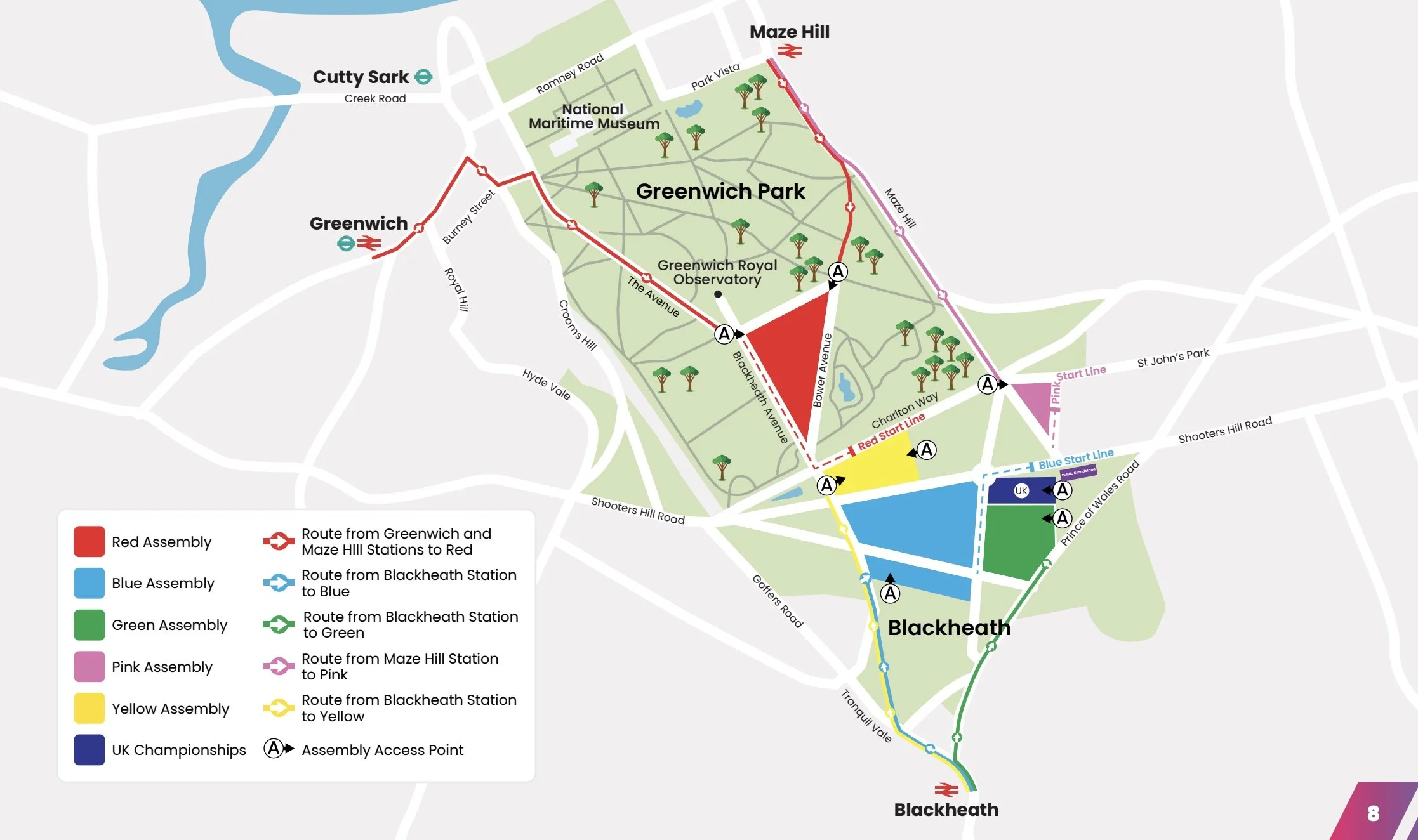
London Marathon start areas at Greenwich
Take layers to the start. Plenty of them
Even if it's forecast to be a warm day (as it was in 2025), it can still be chilly at 8am in the morning in London in April. Take extra layers and keep them on for as long as you can in your start area until the organisers begin calling for your kitbags. Then shove your unwanted layers in there, chuck it on the lorry and see that at the finish.
To stay warm until the actual start, wear an old jumper/cardigan that you can shed on the start line. There are bags to put them in where they will be collected for charity.
Arm sleeves can be useful, too – they’re a good piece of kit as you can peel them off if you get hot later in the race and stash them in your race belt/pocket.
Pace the first 3 miles carefully
It's no Boston in terms of an early deceptive downhill, but at around miles 2 to 3 there’s a slight descent. Take it steady – don't get carried away. There will be a lot of runners and the temptation to weave through them might be strong. If you can hang on, they will spread out as the roads widen around the 3-mile mark where you can increase your pace without wasting energy zig-zagging past slower runners.
Follow the dashed blue line
Glance down and depending on where you are on the road, you might see a blue dashed line winding along the route. That is the correct measured route – exactly 26.2 miles that the elites will stick to like glue.
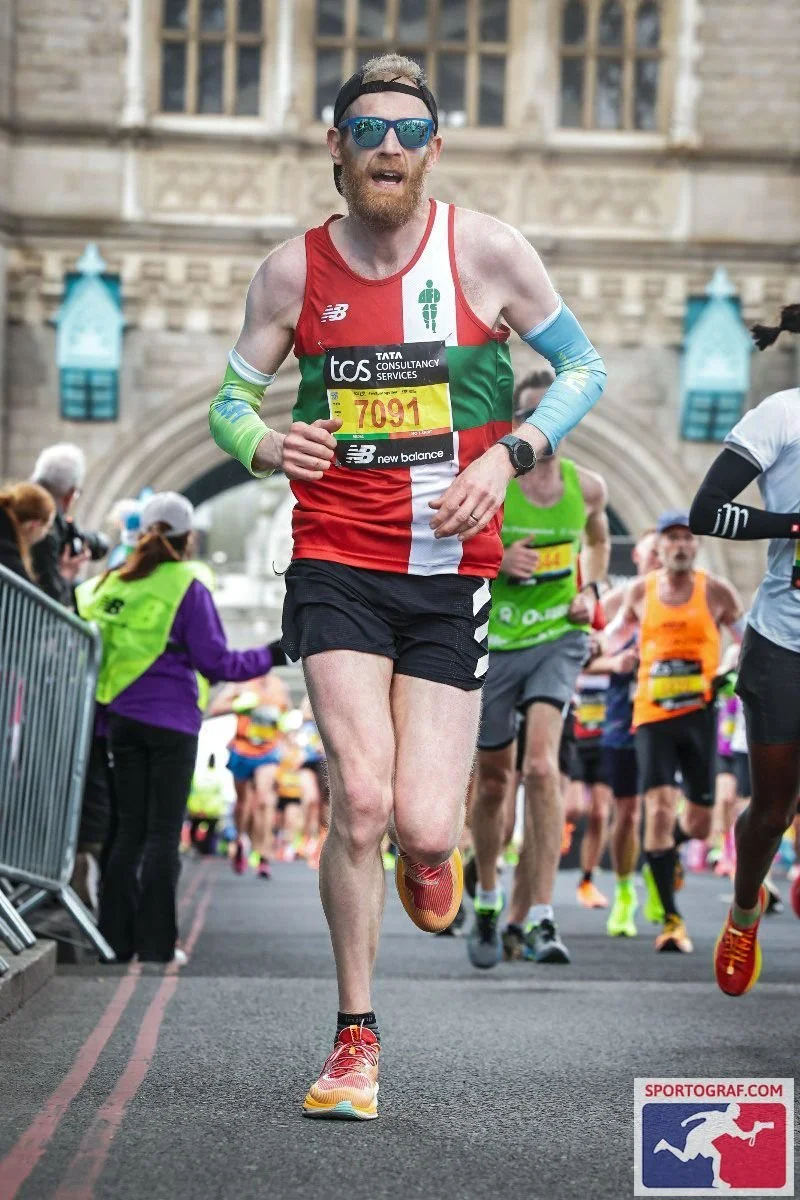
Due to the sheer numbers of people, you will likely deviate from the line – but if you can, it’s worth sticking to (or near), as some runners have been known to run an extra 1.5 miles by running wide of the line and weaving through other racers, which isn't what you want on marathon day.
(On the left you can see I was nowhere near the line when I ran in 2024!)
Look out for kerbs and bollards
There are a lot of central reservations to be wary of, placed in the middle of the wide roads. They are all mostly marked and taped off to help you avoid running smack bang into them. However, there are still hazards to be aware of – mainly kerbs (AKA ‘curbs’ for any American readers) – sometimes in the middle of the road (a notable example is around miles 3-5) - trip hazards that you should be aware of, especially if you are in a mass of runners and you are towards the middle of the road.
The same goes for traffic bollards – you don't want to stack it hitting one of those early in the race.
And don’t forget to look up
One thing London is not lacking en route is things to distract you. But many runners neglect to look upwards (no doubt as they are trying to avoid all the aforementioned kerbs!) – tall buildings surround you, especially round Canary Wharf at 28-30km.
High-rise flats have people cheering on balconies, bridges you run under feature spectators waving above, houses have DJs blasting house music from upstairs windows. It all makes for an atmosphere of pure joy, even if you’re clawing deep in the pain cave.
For other bits of history to spot, check out the feature I wrote for Strava about the hidden history on the London Marathon route – easier to spot if you’re spectating, but runners can keep an eye out too!
You’ll lose GPS signal in Canary Wharf
Don’t panic – it returns. It’s just the surrounding skyrise buildings. But it can throw your pacing stats out of whack for 10 minutes, so if you check your watch and your current pace is significantly slower than you thought, take a breath – it’s just the GPS elves messing with you.
What to expect in the last 10k
This is where the real race starts. For London Marathon runners, at around the point you double back on yourself and pass by Tower Bridge again, you are into the final straight where you track the River Thames all the way to Big Ben. It's slightly undulating, with one long tunnel where peace descends for five minutes, before you erupt out into the crowds again.
At 39km, the road dips downhill under Blackfriars Bridge – and what goes up must come down... the uphill back onto street level can feel like Boston’s Heartbreak Hill, with runners walking and stretching cramped calves. But once you’re back on the level it's flat to the finish.
When you sight Big Ben in front of you, you’re into the home stretch. Turn right at the famous clock tower and you have a short section with St James's Park on your right that feels like it goes on forever.
Eventually, your body slowly sagging with each step, you'll see Buckingham Palace, and the sign saying 385 yards to go. One final corner and there it is in front of you – the Mall and the finish line.
You have done it!
If you finish, and feel like entering another marathon and would like some help beating your brand new PB, get in touch – I’d love to help you achieve your target, especially if you’re over 40.
