First ultra mistakes: what I wish someone had told me before my first 50 miler
Ranking the rookie errors I made so you don’t make the same mistakes
The year was 2016. I’d been running for decades, and had just gone under 3 hours for a marathon for the first time.
It was one of my life’s running highlights, and I was looking for a fresh challenge. I’d run trail races, but never further than a marathon. Ultra marathons were rising in popularity, perhaps trying 50 miles before I turned 40 would be a good challenge, I naively thought.
There was a fairly new 50-mile ultra near me called Race to the King. Starting in Arundel, ending in Winchester, tracking the undulating South Downs Way.
So without thinking too much, I entered, giving me about 8 weeks to train, post-London Marathon.
The race was incredible and unforgettable for many reasons, and it began my journey into running further for longer, and having incredible adventures around the world.
But boy did I make some mistakes. Here’s what I learned:
1. Don’t be overly intimidated by the distance
Nerves are natural before a race, but mine were way out of whack. I spent days obsessing over whether I thought I could actually make 50 miles. I began to doubt my ability to complete the distance. I had never run farther than 26.2 miles. Of course, in the end, that’s all part of the challenge and it was tough but totally doable.
Embrace the leap into the unknown – you’ll come out of it a different person.
2. You have more in you than you think
It’s a cliché, but that’s because it’s true. Because of the nerves, I was cautious in my pacing – too cautious. I took it easy from the start, not wanting to blow up. I walked every incline from the start and as a result missed out on pushing on a bit. My fear of blowing up kept me from exploring my physical limits.
Admittedly, it’s a tricky balance to get right, and it’s something I still struggle with, although now it’s a different issue in that I go out too fast and fade over time.
But one thing I’ve learnt from marathons and ultras is that you can push yourself harder than you think. Be warned, though – it doesn’t always pay off. When it backfires (and it will), it backfires spectacularly. But when it works, and you pace to perfection, there’s no better feeling.
3. Don’t worry too much about gear, but race-specific kit does help
Due to limited prep time, I went into the race without researching kit. I did not have a race-specific vest, just a regular backpack which bounced and rubbed my back raw for 50 miles. Soft flasks? Not for me. Instead I opted for weighty cycle bottles and a Camelbak bladder (I’m still unsure why I had two hydration systems!). All in all, it was heavy, uncomfortable and impractical. But it got me round, so it worked.
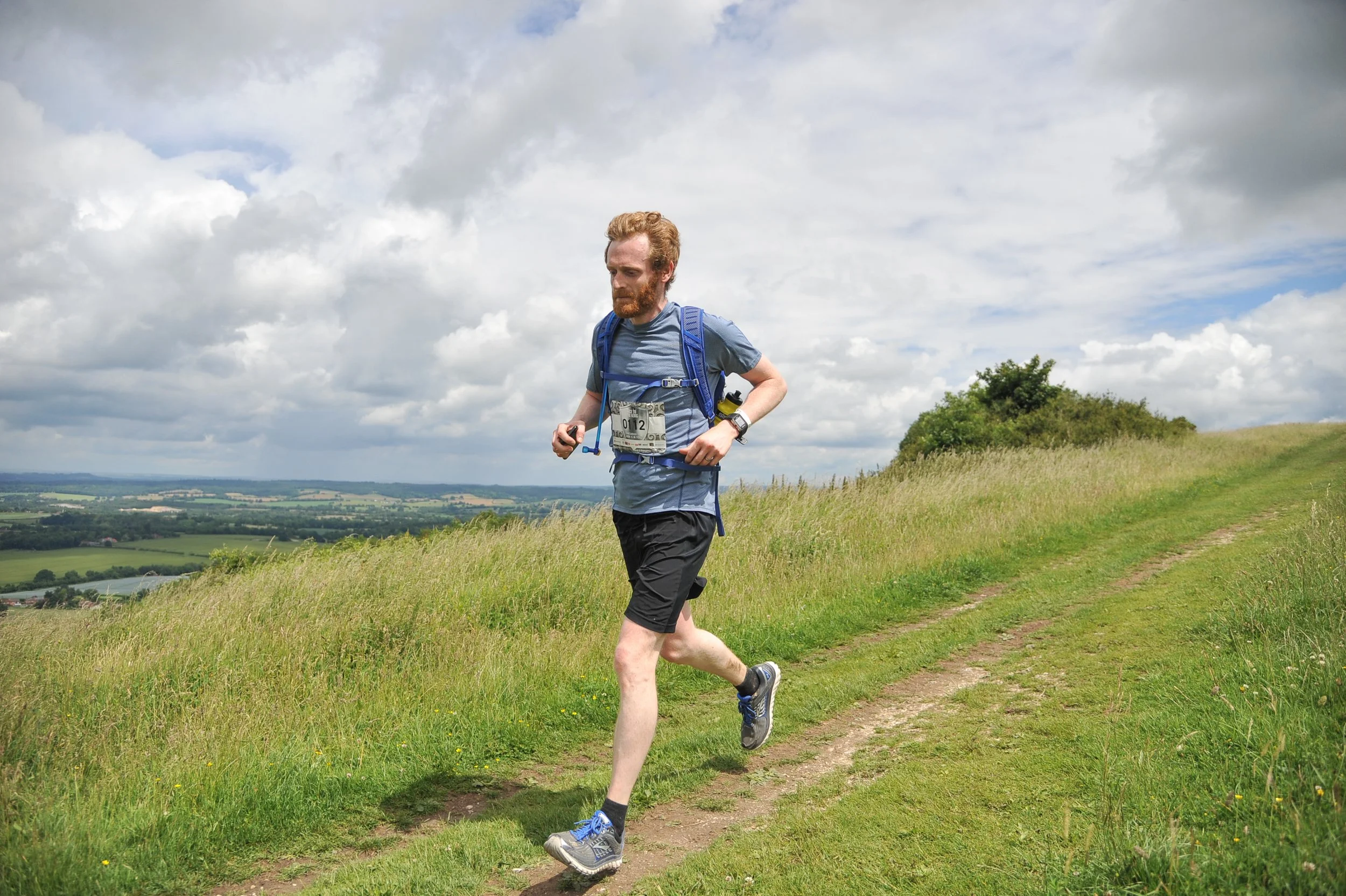
No gear, no idea
4. Race-specific training makes a huge difference
I naively rolled straight from my London Marathon training block into some sporadic training runs. I did no hill reps, I didn’t recce the course, and I blindly thought my marathon training would see me through. It did, although it was a painful second 25 miles.
5. Do not underestimate the value of a good waterproof
Even though it was mere days after the summer solstice, in the UK that means nothing. Halfway through the race, a thunderstorm struck the South Downs Way. It was a spectacular and disconcerting moment, with lightning flashing above Beacon Hill ahead of me as I struggled to pull on my ‘waterproof’ jacket, which in reality was more windproof than waterproof. I was instantly soaked. Luckily, the weather remained warm despite the downpour, but those kind of kit mistakes can be race-ending in other ultras.
Lesson: always test your kit before race day, and follow mandatory gear rules where provided.
“Embrace the leap into the unknown – you’ll come out of it a different person”
6. Have a detailed nutrition plan
My fuel of choice for the race? PB&J wraps. Unsurprisingly, my energy depleted rapidly as the miles went on. Luckily, the aid stations were well-stocked. If I were to go back and do this race again, I would tell 2016 me to fuel with gels and carb mix drinks from the start.
7. Ultra race distances are more of an estimation
When you run a marathon, you know it will be exactly 26.2 miles – and when a course is measured incorrectly, it’s the kind of news that makes headlines.
Ultras, meanwhile, are free and easy with their measuring. A race might bill itself as “100 miles”, but you can expect your GPS to measure it at more like 105. This race was supposed to be 50 – it came in nearer 52. Those extra two miles nearly destroyed me psychologically, and taught me never to trust ultra race organisers’ measuring skills.
Despite these mistakes, the race put me on a journey that I hope will never end. If you are on a similar path, and feel like you could do with some guidance in your training, I can help – find out more about me, and what I can offer at Looped Run Coaching.
