Runners and self-doubt go hand in hand – is there a way to overcome it?
As a runner, there’s one thing most of us have undoubtedly felt at some point, some more than others, some more regularly.
Imposter syndrome. The feeling like you don’t belong. Or you’re out-of-your-depth. That everyone thinks you’re a fraud.
I’ve been running for around 32 years, and I still feel it regularly. Most recently was in the start area of this year’s London Marathon in April.
It was my 10th road marathon. My sixth London Marathon. But still I felt like I didn’t belong.
This time it was because I had managed to achieve a time that put me in the Championship start pen. This is for runners who have achieved sub-2:38 (male), and sub 3:10 (female). If I’m honest, it’s not somewhere I ever expected to be, but my 2:32 time from London 2025 qualified me and there was no way I was going to miss this experience.
In the Championship start area, 600 men and 600 women start just behind the elite men. It’s a surreal situation where I felt very much out of place. My thoughts kept going back to: “I don’t deserve to be here. There are loads of other runners better than me.”
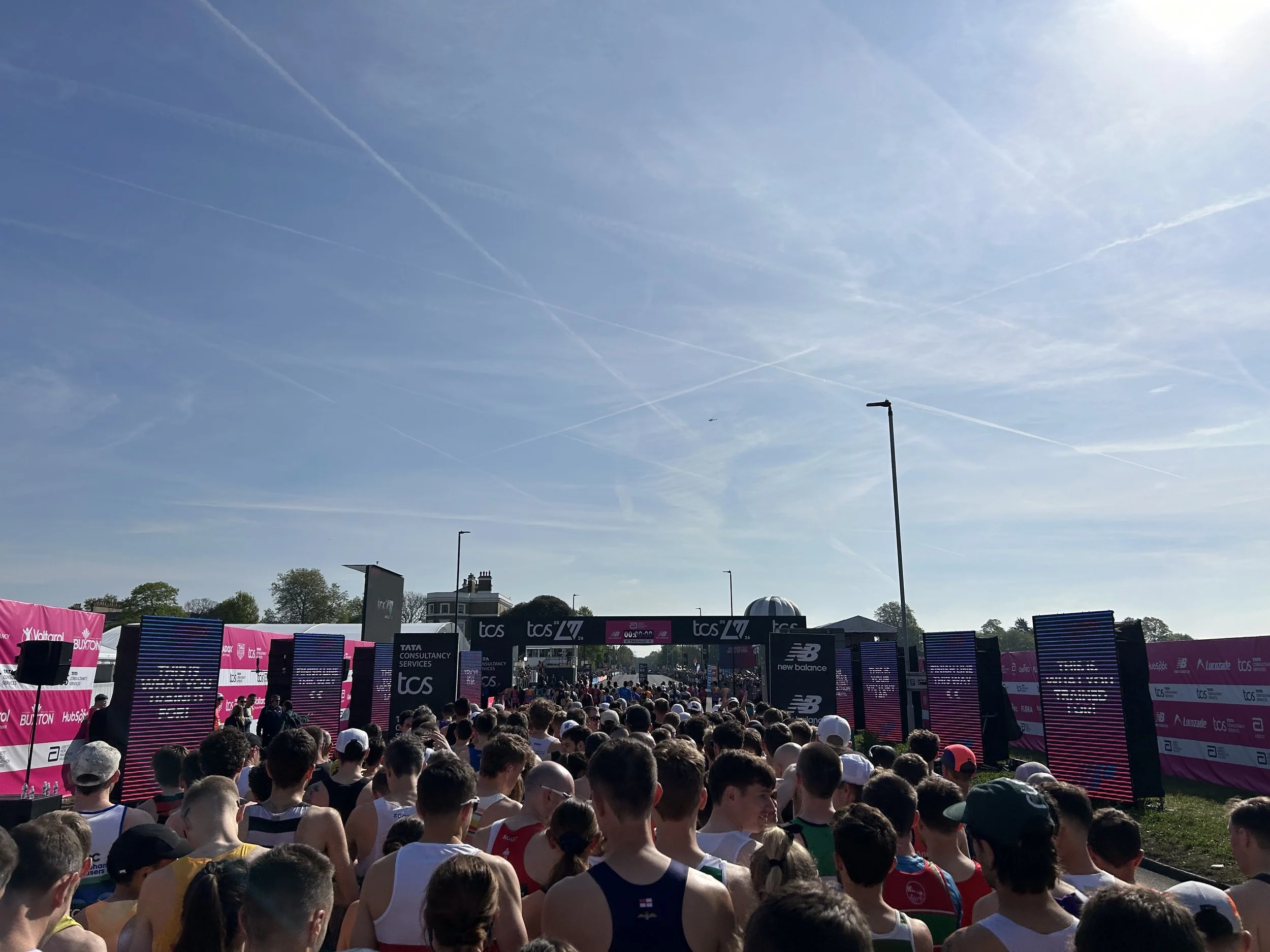
The start line of the 2026 London Marathon
I know I’m not the only runner who feels this. Elites are often struck by it: two elite women who’ve spoken out are US 2:20 marathon runner Jess McClain and Olympic bronze marathon runner turned ultra runner Molly Seidel.
Speaking on The Running Effect podcast, McClain said: “You always feel like once you reach a certain level, [imposter syndrome is] going to go away. And you get to that level and you might be even in a worse spot than you were prior because there’s almost always a bigger fish.”
She added some wise words that could be used by any runner who’s feeling like they don’t belong:
“My path to get here was my path.”
Seidel has also spoken openly about dealing with the issue, both historically and in the present day. “I really deal with a high level of imposter syndrome, I think most elite athletes do,” she said in a Coros Stories interview. “Even though I’ve had a lot of success in my running, there’s also been a lot of hard times. You begin to doubt yourself, but you have to remember that that is just a story that you’re telling yourself, that it isn’t coming from outside. It’s that mean part of my brain that’s trying to keep me from doing anything outside the norm.
“Half the battle of running is overcoming those doubts because they’re always going to come up. The fact that you experience doubt doesn’t mean there’s something wrong with you. It means you’re human. The act of overcoming those is what draws me to endurance sports, and makes them what they are.”
Inside a UTMB icon’s mind
Even Lizzy Hawker, British ultra running legend and winner of UTMB a record five times, felt it at the start of her first UTMB race in 2005 as her inexperience resulted in her donning long johns with holes in and a giant hiking backpack.
“If looks count for anything, I won’t even make it out of town”… Lizzy Hawker during her 2005 UTMB debut. © 2026 Lizzy Hawker
“Most of the other runners seem to look like they know what they are doing,” she said in her book, Runner: A Short Story About a Long Run. “With their skin-tight Lycra, tiny rucksacks and small, fit-looking figures they look like they know what they are in for. If looks count for anything, I won’t even make it out of town.” She admitted she had no idea what to wear, or even any concept of what she was about to do. She went on to win the race.
Another woman (and interestingly few men seem to speak out on this subject – if you’ve seen any, let me know) – triathlete Ali Brauer wrote a great column on her own experience of dealing with imposter syndrome in the sport for Tri247. After coming third in Ironman 70.3 Memphis in 2022, she says happiness was fleeting before dissatisfaction and embarrassment took over, with the inner voice telling her – and this is something I can associate with – “It wasn’t a deep field; you got lucky.”
“Ah, that familiar voice in the back of my head,” she continues. “The one that always makes me question whether I’m deserving of my accomplishments and whether I belong in settings where I’m side-by-side with many other high achievers.”
She rightly says that these kinds of feelings are not often publicly acknowledged, as they might be seen as a weakness. The reality is, all athletes are dealing with insecurities to some degree.
“What truly matters is that deep inside, beneath all my insecurities, I have the self-belief to keep showing up and continue pressing forward … Any adversity, any disadvantages I have faced and any perceived inadequacies I have felt along the way have actually been my greatest sources of strength.”
It’s useful to remember that you’re not alone. As renowned sports performance coach George Mumford says in The Mindful Athlete, “Every human being and every player I’ve ever worked with has some sort of hindrance that he or she is struggling with, whether it’s fear, anger, insecurity, negative self-talk or guilt.”
So if you’re struggling, remember that the runner next to you, fidgeting nervously in their brand new Soar kit and Oakleys, is also battling internally with their own demons.
Start line fears
Back in the start pen of the London Marathon, I was feeling the same feelings I had before my first marathon 22 years previously. The exact same thoughts I tell the athletes I coach to use as fuel. That they deserve to be there just the same as the runner next to them, and the one next to them. You’ve trained. You’ve carbed. You’ve rested. You’ve sacrificed. Just like every other person toeing the line alongside you.
Inside the London Marathon Championship start area
Peering around, it was difficult to shake the feeling. I’m all too familiar with the trap of comparison, but it’s hard not to – the other runners appear fitter and in better shape. I’m just an old guy with a greying beard, receding hairline and a left Achilles that hasn’t been pain-free in two years.
On the trails, I’m more at home. Give me an ultra start line and I feel calm and at peace. Maybe it was the pressure I put myself under – I had thrown everything into a potential last roll of the dice at going under 2hrs 30mins. The vice was squeezing tighter. I tried to relax but it was hard-fought.
I sat on the grass in the sun and chatted to Sam Macaulay who I met during an ultra last summer – he beat me by 20 minutes to take a convincing victory in the Maverick X Series East Sussex 50k, and was here to run London as “a long-run workout” (he ended up running 2:24, showing just how fast trail runners are). A distraction that helped me feel a little less out of place.
I warmed up, did some drills, a few strides in a big loop of fast runners, surging in unison. Then shuffled to the start where squashed in among other runners, the feelings finally began to dissipate. Deep breaths. Down a gel. Bring my attention to the moment I’m in. I do belong here.
Peering over heads at the elites limbering up in front of us. The horn sounds, we’re away, all negative thoughts left behind with my drop bag.
Losing confidence with age
With ageing though, these fears can begin to show up in new and strange ways. Richard Askwith explores this in his book The Race Against Time. He enters a masters 10,000m track race in the 60-65 age category and beforehand, as it’s his first ever track race, he becomes overwhelmed with anxiety.
Despite being a runner for most of his life, completing hundreds of road, trail and fell races, his mind still dived towards the negative: “What if I couldn’t finish, or had to be timed out?” he said. “What if my half-healed buttock let me down? What if I threw up? … That’s what happens when age gets you in its grip: your confidence goes – even when you’ve been a runner for decades.”
The advice he receives from fellow masters runner Steve Peters is refreshingly simple: “You mustn’t say that. It’s mentally damaging. You are a proper masters athlete.”
London taught me this feeling never leaves. In fact, like Askwith, I’m finding it becomes more pronounced with age. I’m a big advocate of pushing yourself as a runner – not just in terms of what you consider possible, but also in different types of racing. This means that often you might feel uncomfortable or out of place. But other runners are almost always friendly. If you’re ever feeling overwhelmed, on the edge of panic, spark up a conversation with the nearest person. Chances are they might be feeling like an imposter too. Or if not, drowning in their own fears or anxieties about the race. You’ll help each other, and before you know it you’ll be racing.
And once you cross the line, those thoughts are long forgotten. In fact, the way I felt at London this year was a faded memory before I began writing this. But I know it might elbow its way into my head again in the future. Next time though, I’m more prepared to elbow back.
The Final Loop
A space for other running things I’ve enjoyed

Go in action during the Saddles 100
A bit of a different short film from Salomon TV – this focuses on Go Miyazaki, who is runs to raise money for a heart charity after his friend Robbie died of a cardiac issue several years ago. It slowly unravels Go’s story as he tackles his first 100-mile ultramarathon, the Saddles 100 in Arizona.
We learn that he suffered knee cancer when he was young, so has major physical barriers to overcome. He also took to drinking heavily following Robbie’s death, eventually ditching alcohol for running and dedicating $0.10 for every kilometre he runs. (In 2025, he ran 3,000km.)
This digs into his race, from his initial anxieties (see above) to the problems he faces on the course, including freezing hands due to a lack of gloves overnight, and running out of water in the heat of the day between aid stations.
The film is a feast for the eyes, with beautiful shots from the varied landscapes the race presents and the prep that goes into it – we even see a sandwich combo Go prepares that I’ve never thought of but am now considering trying – peanut butter and pickles…
It’s an inspiring piece of video for anyone weighing up entering their first hundred-miler. But more importantly it highlights the power of friendship in running – especially in crewing ultras – and how the sport, and these friends, have helped Go navigate his way through grief.
