Wondering what you’re capable of and how you might fare in certain races is crucial to longevity in the sport
How curious are you as a runner? What does curiosity even mean for runners?
Curiosity plays a huge role in training and racing, whether you’re running your local parkrun or 200 miles. You often hear elite runners talk about curiosity, but it’s not often that anyone digs into why it’s an important concept for all runners – one most don’t consider.
Entering your first marathon is fuelled by 120g per hour of curiosity. You’re asking yourself a significant question: what am I capable of? Can my body and mind work together to get me through 26.2 miles? What will actually happen to me, physically? Can I run 26 miles? How will it feel to cross the finish line?
You might have an idea. You might have a vague sense of dread. Maybe based on what others have told you, or things you’ve read about or seen on YouTube. That suffering is part of it. Others might have said, My feet were in bits. Knees gave in. Quads seized. Hit the Wall. Phrases, exaggerations, bravado. Runners like to expand on the truth. But you don’t know that before your first 26.2.
Still, the curiosity tugs at your running vest. Taps you on the shoulder when you’re finishing a 5K feeling strong. You have to know.
A small number persevere. Despite trepidation and the unknown, our desire to find out pulls us in. And that curiousness overcomes everything, until you’re in the start pen, bib pinned, shuffling nervously forward with the mass of starters. Stomach roiling. Trying to calm the mind. Cursing your curiosity. Waving your fist like Abe Simpson. Damn you curiosity, what have you done? But it’s too late, the numbers count down and you’re swept along. In it.
Once you cross that start line, you’re forever changed. Part of the 1%. You know what it’s like to run a marathon.
Curiosity does not end there. Many return to the marathon stage to find out: can I beat that time? What if I try a different training plan? What if I take more gels? Try different shoes?
And you’re entering the ballot again.
“Curious is a good word.” Lazarus Lake, The Hillbilly Scientist
At a panel during the recent Run Culture: Live event in London, ultrarunner Lucy Bartholomew was asked why she returned to race UTMB again this year. Her answer involved the C-word: “Curiosity. I was curious how I would run UTMB for the fourth time.”

Me struggling against a horse in the 2017 edition of Man v Horse in the Brecon Beacons
She knew the course. She’d trained differently. She was faster. But that guarantees nothing. Curiosity switches your brain to open: open to the idea you can do better. Beat your ghost. Prove to yourself you have more to give. You can show your past self. We all know no one else cares. But we do. We care. We care deeply. So deeply we train for three, four, eight, 10 hours a week for months at a time. It’s what keeps us coming back to the same races again and again.
It doesn’t end there. Curiosity has seen me question what it would be like to run 50 miles on trails. Then 100km in the mountains. A skyrace? 100 miles along the South West Coast Path in the middle of winter? The 3,000m steeplechase? A race against horses?
It goes deeper. It makes you question your skills. Your mental fortitude. How you cope under extreme stress and in the lowest lows. Will you hold your nerve? Or will you fold?
Your curiosity is only ever sated temporarily. It rises again. Claws its way back up your poles, over your hydration vest. Seeps through your skin. Into your psyche. Until it’s part of how you define yourself as a runner.
“It’s about a question you can’t quite shake: ‘Who am I when there’s no easy way out?’” writes Don Freeman & Scott Warr in the intro to Ian Sharman’s The Art of Ultrarunning. “The runners who keep showing up, year after year, tend to be the ones who stay curious about what the day is giving them instead of clinging to what they thought it should be.”
When things don’t go to plan during a race – and they rarely do – how will you react? You don’t know before it happens. How your mind will show up. Will it learn to adapt and move forward? Whatever the race flings at you, you can only learn with age and experience.
This is where masters runners are at an advantage. Those who have run races over years, decades even, can dig around in their toolbox and grab the correct tool for the job. You learn it might not be the race you wanted but if you remain curious as to how you’ll deal with this setback, instead of panicking that your plan’s failed so you might as well DNF, you have the potential to cross the line and receive a medal. In many ways, a sweeter finish, even if it’s not the one you dreamt of.
Keep curiosity close to your heart the older you get. It will keep your mind open to fresh running experiences: new run groups, different types of races, different styles of running. Running is running, after all. And curiosity keeps it fresh, fun and ever-evolving.
The Final Loop
A space for other running things I’ve enjoyed
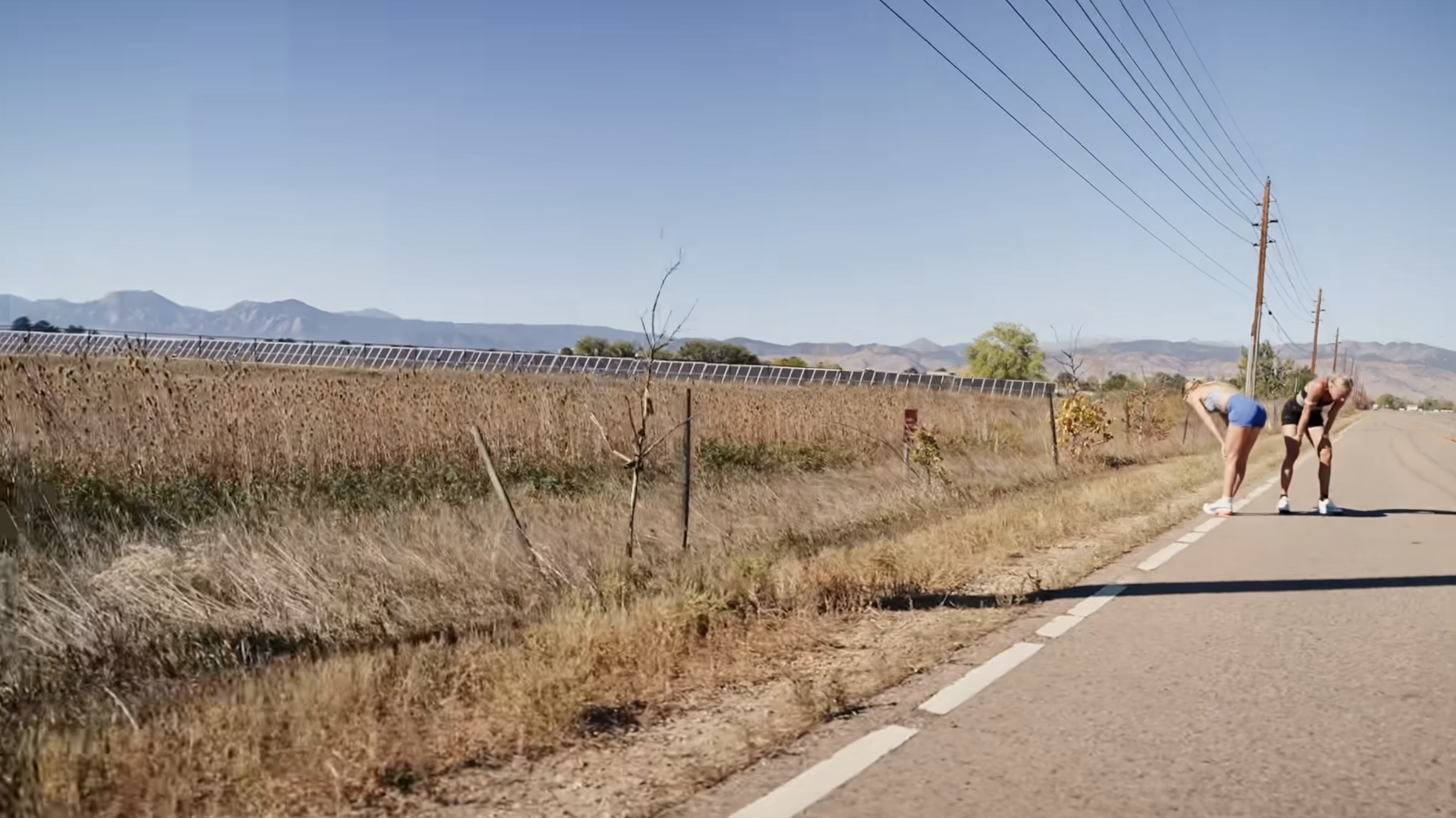
‘A Brutal Day Training For my First Marathon’ – Allie Ostrander
Allie Ostrander brings a lot of energy to her videos, and that’s why they’re so watchable. She’s a talented half marathon, 10K and 5K runner, but recently announced she’s taking on her first marathon at CIM on 6 December. But first, there’s the small matter of Valencia Half. So her coaches, David & Megan Roche, have programmed a spicy 4 x 2 mile workout at half marathon pace.
“It’s an important workout, and I know it’s important, so I care,” she says. “Therefore I’m nervous.” Anyone who has undertaken a workout that includes holding a daunting pace can associate.
We get a small window into her fuelling tactics, which begin with a homemade burnt pancake followed by targeting 100g an hour via SiS Beta gels and Skratch Labs carb drink for CIM – this workout is her first test at that amount, having built up to 60g, then 80g. “A test of the mind, body and stomach,” she says, neatly foreshadowing what’s about to happen.
Her friend and training partner Lauren Gregory – who recently won OCC in a finish for the ages – joins her for the session. Seeing them mentally break down the intimidating reps into “essentially one by two-mile” is pretty amusing – and good to know that even elites are overawed by tough workouts.
The short film shows how camaraderie can help you through a brutal session. The fuelling didn’t quite go to plan Allie admits – there’s work to do. But she made it through – it will be interesting to watch her progression.
Roots: Inside the Mind of a Champion Ultrarunner – Ruth Croft

New Zealander Ruth Croft is one of the best ultrarunners in the world – as shown by another stunning victory at Diagonale des Fous on Réunion Island last weekend – and this documentary covers her background and run-up to UTMB 2025.
Director Alexis Berg has created a visual feast, including cinematography and sweeping drone shots of NZ backcountry that will have trail runners salivating.
Ruth’s story is an important one. A talented athlete at school, her relationship with food became fractured in her teens, leading her to develop bulimia and consequently constant stress fractures for four years, which saw her reset her relationship with running.
She essentially quit the sport altogether, moved to Taipei and partied hard in an attempt to escape the issues she’d faced. Eventually, she found a welcoming run community, and began to return to the sport she loved – but this time on her own terms.
The most shocking part was Ruth saying she did not have her first period until she was 27. By being so open about her own journey, she is hoping to make more runners aware of the issues surrounding disordered eating and running, especially teens. This – and podcasts like marathon runner Jake Smith recently talking about overcoming RED-S on the Life in Stride podcast – make the subject less taboo, and normalise talking about it and in doing so highlight the dangerous road it can lead down, and crucially, how to get help.
Ruth began to build – stronger and fitter than ever before – and thanks to her local run club found a new love for trail running. “It had become comfort,” said Ruth. “Familiar.” It wasn’t long before the wins started coming. OCC. Tarawera Ultra-Trail, Western States, leading to the big dance: UTMB in 2025.
A DNF at Transvulcania earlier that year schooled her in preparing properly for bad weather – including taking enough layers and getting them on quickly before your core temperature drops – which she put into practice during UTMB when the weather was less than ideal.
I couldn’t help but smile when she commented: “On way up the Col [du Bonhomme], I had thoughts of what the fuck am I doing with my life? I could be tucked up in bed.” Showing even the pros have the same thoughts we all do during 100-mile races.
Another interesting snippet was her breezily adding, “Running 100 miles can be very pleasant. It doesn’t have to be this horrible sufferfest.”
I would echo this sentiment. With the right training and pacing on the day, it should be pleasant for most runners – unless perhaps you’re racing at the sharp end.
Meditation helped her through the darker times, and Ruth still has thoughts about the impermanence of life at the forefront of her mind, saying that even a win like UTMB does not make her feel any real emotions, as “it doesn’t mean anything”. However she views her results, there’s no question she inspires countless runners and non-runners across the world, myself included.
