A nod to the Futureheads for the apposite lyric: “Every time I listen to my heart/It's like a cartwheel in my head, but my legs are made of lead”
At the end of September, I took part in the SEAA Road Relays. It’s an annual event where athletic clubs from across the south of England convene on a race track and run 6km legs – the vets do four, the seniors six.
I was part of my club’s V40 A team, and it all takes place just down the road from where I live on an asphalt racing track in Aldershot normally closed to the public – at the – as Cottage coach Mark Lloyd excellently put it – “lugubriously named” Rushmoor Arena.
Each runner completes two 3km loops of a course best described as “undulating” – some describe it post-race as “hilly” with a look of subdued terror in battle-glazed eyes – before handing over to their next teammate.
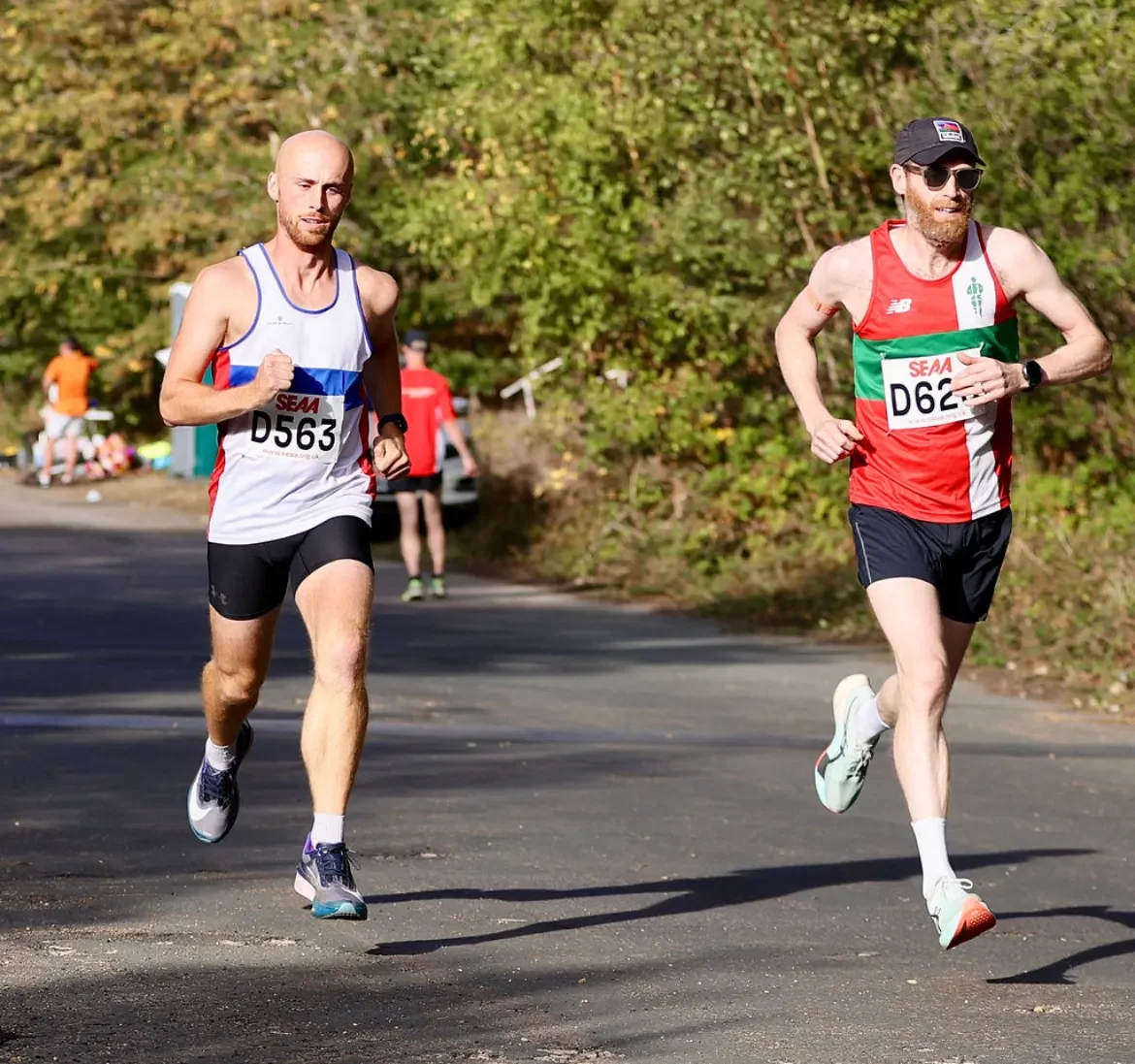
That’s me on the right, representing Aldershot Farnham & District, getting reeled in by Portsmouth’s senior team
I have taken part once before and it is chaotic fun. Watching the changeovers is enthralling – the incoming runner – usually soaked in sweat, going full pelt having given it everything – slams into the flimsy rope barrier separating the awaiting, next-leg runners. A sweaty high five and the teammate is off.
I was on the final-leg duties. That meant an hour of anxiety building. A pressure cooker unlike a normal race, where everything falls on you and you alone. Make a mistake? It’s only your result at stake. It’s not often in running you’re part of a team, but it brings a different type of pressure.
1983 London Marathon winner Mike Gratton told me afterwards that he clocked some of his best 5K times within relays due to not wanting to let his team down. “It’s not about PBs, it’s about giving it your all for your club.”
Giving it your all.
Four key words. What do they mean, exactly?
Going to the well. Burning all your matches. Squeezing out every drop. Going through the wringer.
As runners, it often begins at school. If you were within even a slight whiff of victory, you would utterly deplete yourself in an effort to take first. Then into your twenties, putting in huge efforts during interval training, collapsing at the end, staggering, hands on knees, ribcage heaving.
Recovery, at that age, is swift.
Recovery, post-40, is a different story.
Muscles tighten, joints ache, tendons strain. The thought of how you will feel the following morning when attempting to clamber out of bed is often enough to rein you in.
So you ration your all-out efforts. Save them for A races, or key training sessions. As writer and coach Steve Magness said about his own training philosophy:
Mostly easy, occasionally hard, vary it up, and very seldom, go see God.
At the relays, I saw God. There, at Rushmoor Arena, yelling, “Let’s go!”
I also saw blurred forms. Darkness closing in. Tunnels. I heard muffled shouts. Occasionally my name.
The last 1,000 metres was pure survival. The thoughts of quitting were there. Or at least if not quitting, slowing slightly. Similar thoughts to when I run 100-mile ultras. But these almost felt stronger. “This is madness,” my brain chipped in. “Why are you doing this? Look at your heart rate.”
I looked at my watch. 183. Yikes. Looked again. As high as I’ve seen it in any race for a long time. Is that safe for a 47-year-old? What does ‘safe’ even mean?
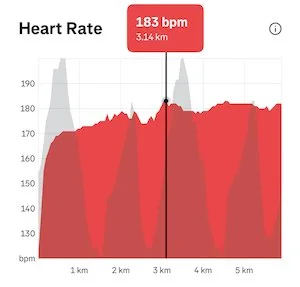
How high is too high? My HR peak during the 6K race
A new battle to blank that ‘central governor’, trying to make me slow to save my body from harm (if you believe Tim Noakes’ theories of how we regulate our bodies during exercise). That is the biggest battle. Is it possible? It certainly gets more difficult each year you get closer to 50.
I glimpsed the finish. Deceptively close. “Just one long downhill. I can coast it.” Except there was no coasting. It was pushing, pushing, pushing.
Mouth gummed. Saliva retreated. Metallic taste at the back of the throat. Rust. It’s been a while.
Summoning every muscle fibre. Every workshy mitochondria. Thankful for slurping down some bicarb before the race. Increasing speed ever so slightly when the finish is in sight. Catch… that… runner. (I didn’t.)
Vision honed purely on that white line, spray-painted across the rough asphalt.
Relief.
Fumble to press stop on my watch. Doubled over. Face burning. Coughing. Hacking. Pulse in my ears, bellowing. Wobbling towards the queue for water. More water. Full vision gradually returning.
Our team came 4th, just 13 seconds behind 3rd. Inevitably, my first thought, ludicrously, was could I have knocked 13 seconds off my time?
Why does that happen? Why, when we’ve given our all, does your brain go straight to what more could you have done, when five minutes previously it was yelling at you to slow down?
Most runners think that those who finish first finish with a calm brain. Happy at the result. But even for the winners, negative thoughts intrude – could I have done more?
That doubt, it lingers. But that doubt is what keeps you returning, time after time. The same distance. The same race. That nagging thought, you could have run that incline faster. Why did you slow there? The joy of running.
Welshman Steve Jones – a 2.08 marathoner – was famous for putting himself through this kind of pain on three workouts a week: Marc Plaatjes described him as an “animal” in workouts: “We did a hill workout, after the first one, there was Steve, hunched over at the top of the hill, vomiting … After each hill, Steve was there vomiting. He just runs so hard.”
This was the early 1980s. Attitudes were different, and few elites would even consider doing that kind of workout these days. But it demonstrates the eternal draw of pushing the limit – and the perceived benefits.
For athletes over 40 – can you keep doing this? Or, more importantly, should you keep doing this?
The answer is a resounding yes.
Not only because the science shows it’s good for us, and if we don’t do it regularly, we begin to lose the ability to do it at all – but also because it’s fun. (Admittedly, only fun afterwards, once you’ve finally recovered.)
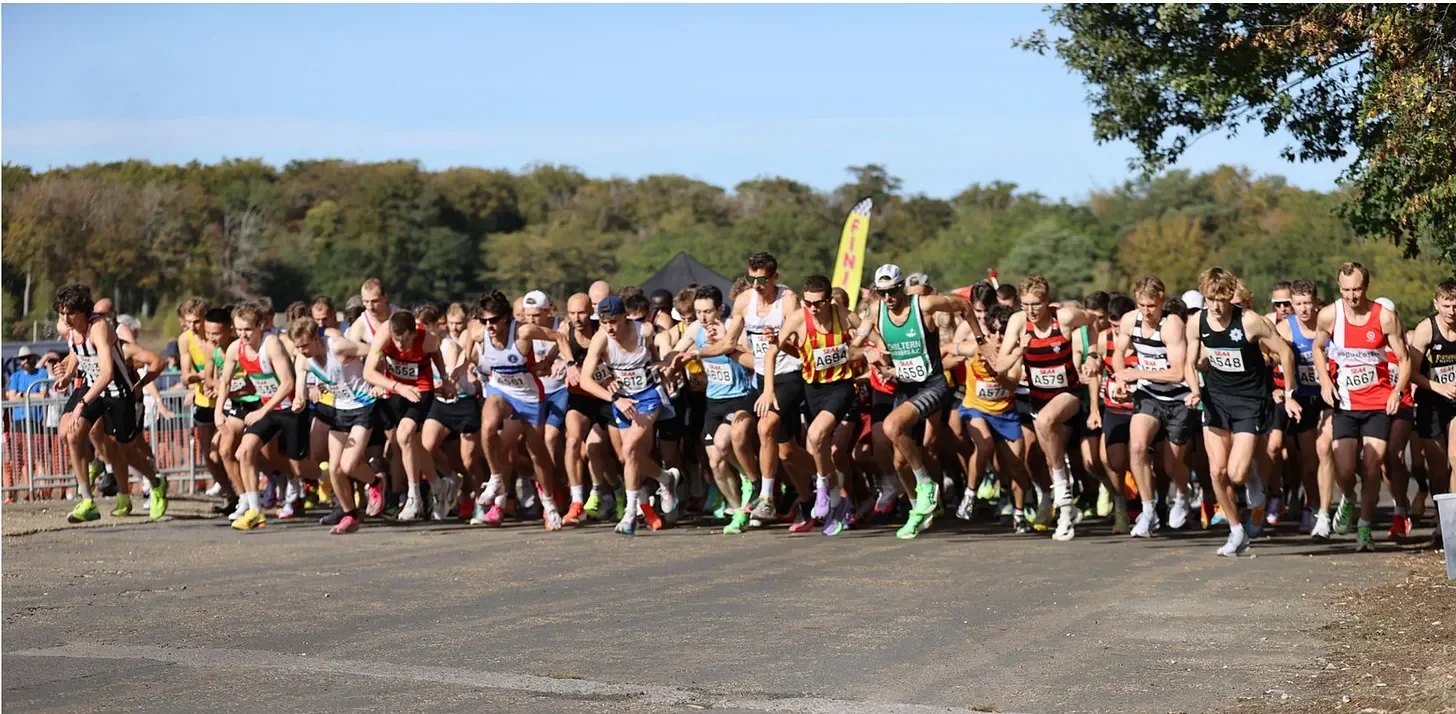
Elbows out … the start of the senior and vet men’s Southern Road Relays 2026
Back to Steve Magness for a second, as he also posted a recent note that hit home on this exact subject:
While running 400m repeats, my coach once said to the group “Your parents probably haven’t felt what you are feeling for decades. Maybe even ever!”
A reminder that once in a while we have to remind our body what it’s like to go to the well and use all of the systems of our body.
So how often should you put your body through the wringer like this? And, more importantly for many, why bother?
Running hard keeps your VO2 Max up – as does the training that gets you in shape for race day – and as you creep into your 40s and beyond, you begin to lose roughly 1% of your VO2 Max a year without training – this 1990 study found that masters athletes who kept training lost around 5.5% over a decade, while the average sedentary population lost 12%.
Why is it important? VO2 Max has been shown to be a key metric in terms of longevity, even if it’s less important when it comes to marathons and ultras.
The Rogers study also found that masters athletes’ maximum heart rate remained unchanged at 171 over 8 years, while the sedentary cohort dropped from 171 to 163 over the same timeline.
Endurance athletes are again at an advantage here, with wider blood vessels that have adapted to years of transporting extra volumes of blood round the body, and a muscular heart still rapidly pumping precious oxygen-rich blood round your body – which all ageing runners need a little help with.
And if you don’t keep regularly running fast, you begin to lose that ability to fly. And for every year over 40, it becomes harder to get it back.
There’s a well known 1997 study by Dr Michael Pollock who followed 21 athletes over 20 years, from the age of 50 to 70. They were split into three groups: one group continued high-intensity training, one group did medium intensity and one group low intensity. The high intensity group lost 8% of their VO2 Max over a decade from age 50 to 60, while the more sedentary low intensity group lost 18%.
Think of it like maintenance. Going to the dentist for your annual check-up. You know it’s got to be done, even if you can’t always be bothered. And when it’s over, you feel better.
Like frosting on a cinnamon bun – your aerobic capacity is the pillowy soft, cinnamon-filled dough. It needs to be fluffy, well-risen. You only then need a small amount of high-intensity running – close to the short, fast event – AKA the delicious frosting.
There’s something slightly addictive about the feeling of going to the well, though. That pureness of expending every ounce of energy over a short distance.
Balance it carefully with the risks – injury is always lurking around the corner, waiting to strike your Achilles or hamstring with a sniper’s accuracy – but with intelligent, well-planned training you can balance the risks. You can do this by building appropriate speedwork progressively into your training, adding strength work and scheduling regular, targeted rest.
You might even enjoy it the race when it arrives. Even if your legs feel like lead.
