Why ultramarathon runners should run cross country
Cross country.
Two words that can instil fear into many.
Memories flood the senses: trainer-sucking mud, puddles fringed with ice, lungs smarting in the frigid air as the battle to round the final corner and cross the finish line to end the misery seems like an impossible dream.
Some take brazen shortcuts when they think their PE teacher isn’t looking. Others simply refuse to run and instead walk in protest. The result is that school cross country puts many teenagers off running for life.
For my own part, I was one of the annoying types who relished cross country. My first proper race, running for my school around Woollaton Park in Nottingham aged 12, sticks in my mind to this day. Red-faced, mud-flecked, half-delirious, I stumbled over the line, nowhere near the top 10 but unable to talk, having maxed my effort and pushed myself to my preteen limits while hopping roots, leaping ruts and squelching through sodden grass.
I often wonder if that’s where the seeds for my love of trail running were sown.
Fast-forward 35 years and I’m now 45. Over the past three decades, I’ve run an array of distances and terrains, from 5km Parkruns, duathlons and triathlons to road marathons, mountainous sky races and 100-mile Alpine races.
But one type of race was missing from my rosta. Cross country. Something about the wild eyes, the snarling, gritted teeth, the suffering, the spike-churned surfaces, the 40 minutes of red-lining to see what you have within you appealed to me in some weird way I couldn’t quite put my finger on.
I guess it was seeing what I could extract from my ageing, increasingly tired, ever-more-inflexible muscles, my groaning joints, my rasping lungs. And the thought that whether a racing a cross country season could help performance in marathons and ultras.
“Something about the wild eyes, the snarling, gritted teeth, the spike-churned surfaces, the 40 minutes of red-lining to see what you have within you appealed to me in some weird way I couldn’t quite put my finger on”
Aldershot, Farnham & District athletics club is based just down the road from me. It has produced an intimidatingly medal-strewn list of British athletes, including three-time Olympian and three-time British 5k champion Steph Twell, 2:22 marathon runner Charlotte Purdue, Louise Smalls, Chris ‘Tommo’ Thompson, Zola Budd and current up-and-comer James Dargan.
Before I joined the club, I wasn’t sure I had any right to turn up and try to run alongside the incredible talent training there. Battling those mental demons, however, was the stubborn thought that this opportunity wouldn’t be around forever and I was only going to slow down with age.
It was now or never.
The start of something
So in late 2023, weeks after finishing UTMB, I arrived for my first training session and was put in a friendly group of junior runners one-third my age. Before there was time to think “is this actually a bad idea?” we were off, pacing ourselves through an interval track session that brought back teenage feelings of pushing my body to its limit. I loved it.
Cross-country season had just kicked in, and the next race in the Hampshire League was approaching. The venue: Popham Airfield, just outside Basingstoke, for three laps of a 3km route, largely over open fields with a short, rooty, wooded section.
The weather was amenable, the turf was relatively dry. I had not even had time to purchase a pair of XC spikes, so I turned up in lightweight, grippy trail shoes as everyone around me was discussing what length spikes they’d gone for. The imposter syndrome was real: what was I doing here?
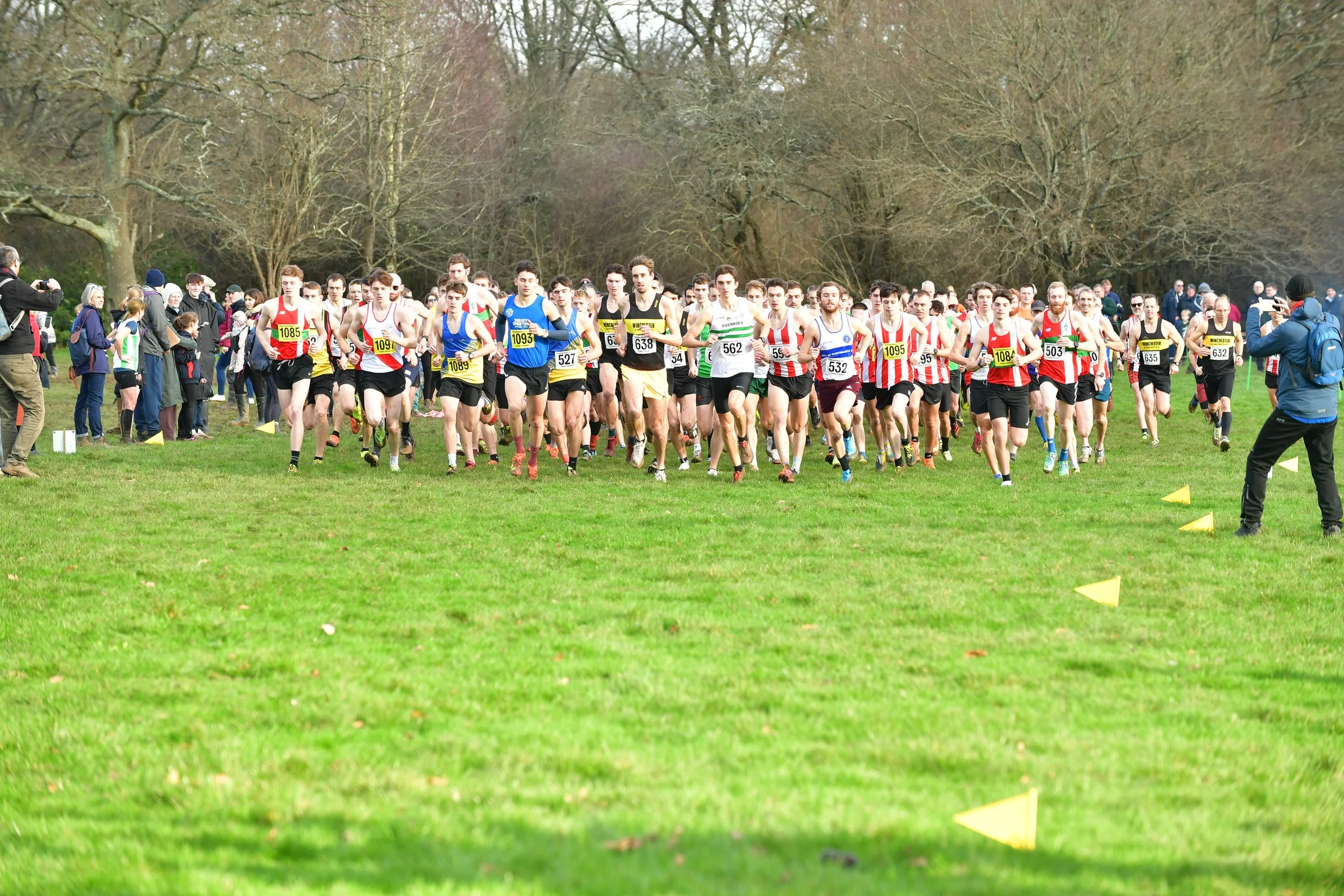
At the startline, I tried to dampen these feelings down. The men’s senior race was packed – more than 200 fidgety runners lined up, elbow to elbow, bouncing on their toes like thoroughbred horses about to be unleashed into the wild. Most of them looked to be in their 20s, but it was reassuring to clock a handful of grey-haired or balding vets dotted about.
The low-key aspect is what draws runners into cross country. No sponsors, no inflatable start lines, no medals, no DJs attempting to whip up some atmosphere. Just a silver-haired chap in glasses and battered high-vis who gets the race going with an understated, “Ready, set, go.”
As expected, the pace is blistering. I’m practically sprinting, which I know I’ll regret on lap three, but I can’t slow down – adrenaline, excitement, fresh legs, the coffee I’d downed just before starting – my inner 12-year-old is yelling with excitement, encouraging me to go faster and, despite the pain that lies ahead, as the wind flaps my vest, a grin inches across my face.
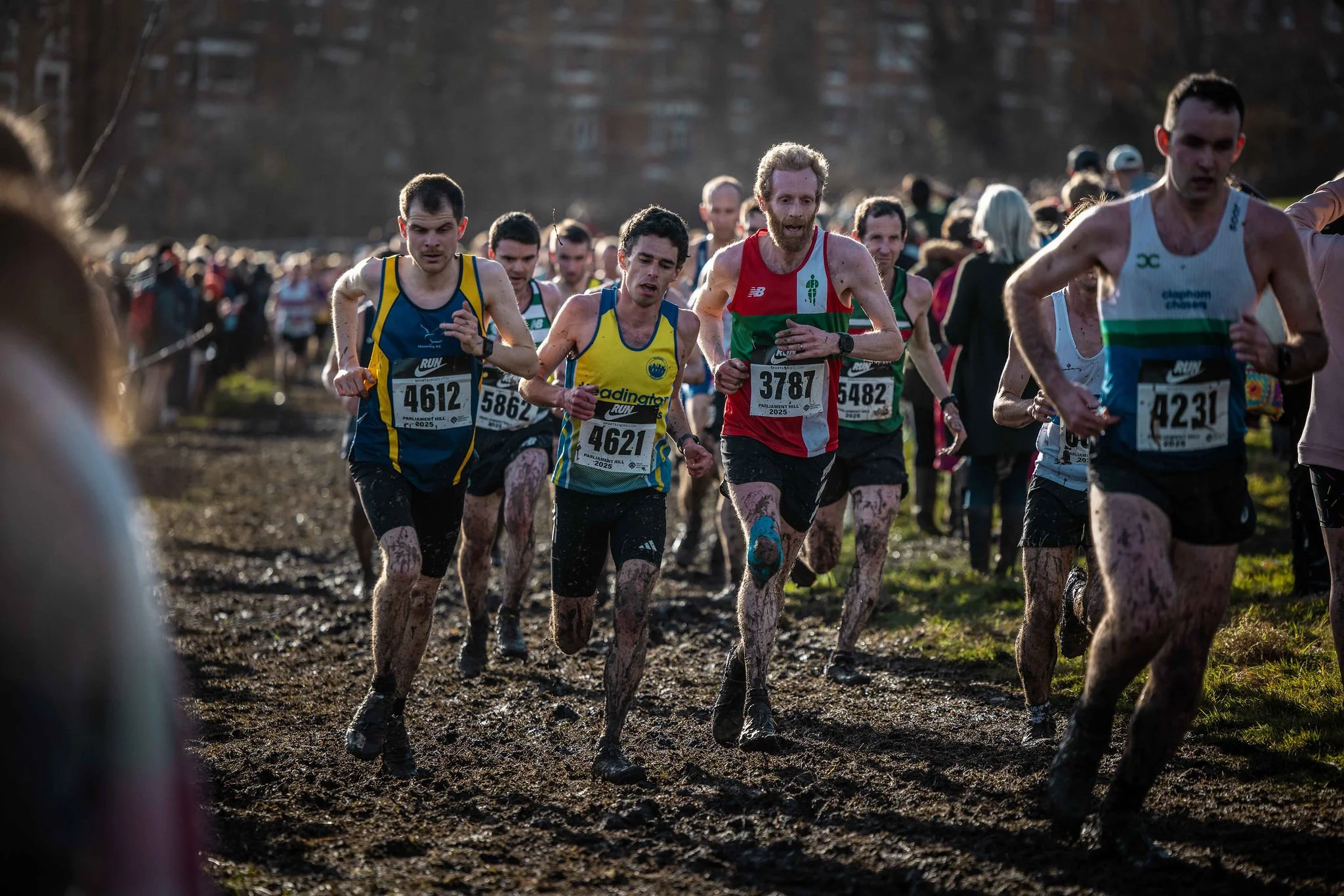
The 2025 Parliament Hill mudfest
A peek inside the cave
As the starting bunch slowly strings out over the initial lap, the suffering knocks on the door with a firm rap.
I should probably drop the pace. Save something. But my legs feel good despite my HR rising and a pace that’s unsustainable for much longer. I press on. Runners occasionally pass me, but I focus on turning my legs in a steady rhythm, grinding my way up what appear to be gentle inclines but deceptively sap precious energy and lung capacity.
Lap one completed. The temptation to collapse and call it a day is strong. How am I going to do two more at that pace?
It’s now a case of finding out how much pain I can endure, and for how long. My heart rate is nudging 180, but there’s little time to bring that down – just focus on the next corner, I think. The gradual climb, the flatter sections where I can try to catch my breath and rest my aching quads. Avoiding the ruts and potential twisted ankles.
Quads burning, legs jellifying, lifting them is all I can do. What do I have left?
Today, we die a little
Eyes off my watch. Milky light edges into my vision, My breathing is ragged, on the cusp of out-of-control. Trying to remember this is supposed to hurt, pain is helpful. Or is it the breathing of the guy behind me? Feet pound into the soft earth, stumble round tight corners, on and on the final climb, finish in sight, downhill now. I can do it.
The finish. Brief respite. I can walk. Hands on knees. Retch. Again. Blood thudding in my ears, mouth dry, the fields surrounding me swimming. Relief at not having to run any more.
I finished 52nd, 8th in my age category. Twelve-year-old me would, I hope, at least afford me a respectful fist bump for making it round without collapsing.
Like all other runners taking part, a few hours later, the agony of racing is a distant memory. Replaced by the euphoria of staggering over the line, that peculiar gratification of a race run hard, thankful I’m still able to take part in events like these.
And, before I’ve left the car park, my thoughts turn to the next race, when I can put myself through all this again.
How all this helps your ultramarathon training
The point of this rather long, meandering story? How running cross country is ideal training for ultramarathon runners.
After all, Tom Evans regularly pulls on his club vest and races XC, and has even represented Team GB. So if it’s good enough for a UTMB and Western States winner, surely it’s worth all runners having a go?
Yes, they’re completely different beasts. Ultramarathons involve hours of aerobic running. Cross country is all-out effort for 30-odd minutes. How can one help the other?
There are a number of ways cross country can help your ultramarathon training:
It’s run over terrain you’re likely to be running in your target race.
It gives you good startline practice – just with jabs from elbows rather than running poles.
It prepares you for visualisation work – seeing the finish line, picturing yourself crossing that line – all useful practice for doing the same thing in a more focused manner on your A-goal race day.
It preps you for handling pain, albeit a different type of pain than ultra running – but both involve mental battles and overcoming powerful feelings of wanting to quit.
It gets you doing some longer threshold work. Working on boosting your top-end speed and endurance will help you during longer ultras.
It’s racing at its simplest – you don’t have to be concerned with carbs per hour or how many layers you need. As Tom Evans says, “Just chuck on shorts, spikes and vest and just go.”
I’d encourage all runners to dabble in a little cross country for all of these reasons, but mainly because it’s fun. It adds variety, new stimuli – both mental and physical, and camaraderie, as you’re scoring points for your club.
For most ultra runners, the XC season slots right into your off-season, especially if you’re building towards a summer ultra. Your next race is likely a few months off and, if you’re building an aerobic base, some speedwork is useful before you get closer to the big race.
In training programming terms, it’s reverse periodisation, with high-intesity speedwork taking place early in the training block over winter – when the weather is often not ideal for long, slow runs – before you begin building high-volume aerobic work and more ultra-specific training as your ultramarathon approaches.
